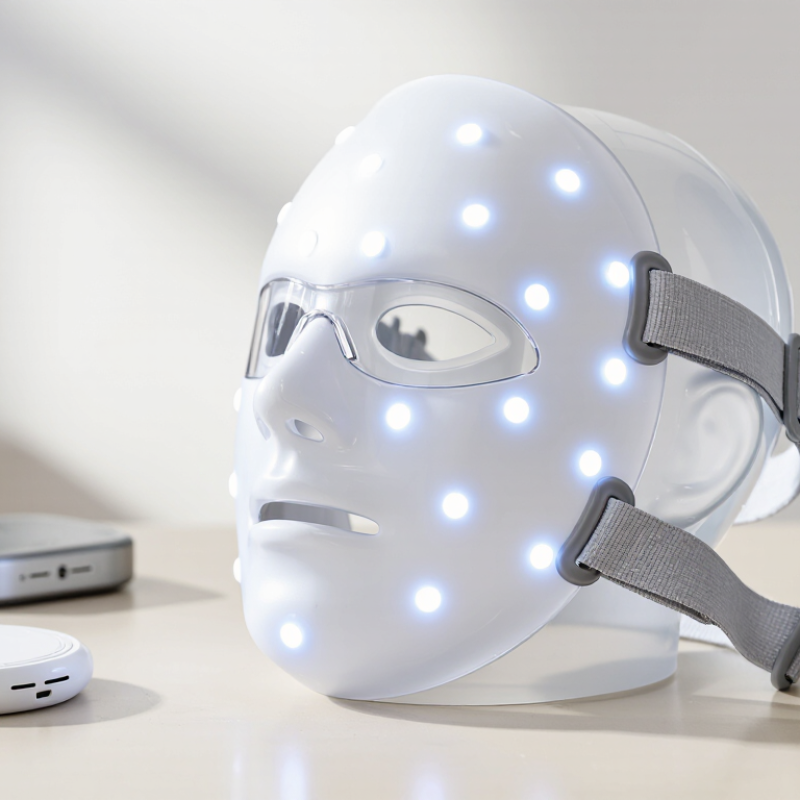
| Red LED wavelength | Approximately red light at 630–660 nm | This range is widely used in photobiomodulation devices intended to support the appearance of skin firmness and fine lines. | Request independent optical test data showing the measured wavelength and tolerance, not only marketing illustrations. | Essential |
| Near-infrared wavelength | Typically 810–850 nm when near-infrared LEDs are included | Near-infrared light is commonly added to increase wavelength coverage and may reach deeper tissue than visible red light. | Confirm the exact wavelength, optical output, eye-safety instructions, and whether the near-infrared LEDs are independently controlled. | High |
| Blue LED wavelength | Approximately 415–470 nm, preferably with controlled exposure | Blue light is commonly used in skincare devices designed for blemish-prone skin, but it requires clear eye and skin-use precautions. | Check the measured wavelength, treatment limits, contraindications, and whether a light-blocking eye shield is supplied. | High when included |
| Irradiance at the skin | A clearly documented, measured output; many consumer devices operate in the approximate range of 10–60 mW/cm² | Irradiance determines how quickly a treatment delivers energy and allows buyers to compare devices more accurately. | Ask for test results taken at the actual skin distance across the full face area. Avoid relying solely on LED count or electrical wattage. | Essential |
| Energy dose per session | Usually documented in J/cm²; a transparent specification is more important than a high headline number | Dose combines irradiance and time, helping users understand the total light energy delivered in one session. | Check that the stated dose is consistent with the formula: energy density = irradiance × treatment time. | Essential |
| Treatment timer | Automatic shut-off with a clearly stated cycle, commonly around 10–15 minutes | A timer improves consistency and reduces the risk of unintentionally extending exposure. | Test the timer during a sample session and confirm that the device cannot continue indefinitely without user action. | Essential |
| Silicone material | Soft, flexible, skin-contact silicone with documented material composition and low odor | Flexible silicone can improve facial contact, comfort, cleanability, and fit across different face shapes. | Request material declarations, skin-contact test reports, and samples for checking flexibility, seams, odor, and surface finish. | Essential |
| Facial coverage and fit | Even coverage across the forehead, cheeks, nose area, chin, and jawline without excessive gaps | Uneven distance from the LEDs to the skin can produce inconsistent light exposure. | Inspect a light-distribution map or use a sample to evaluate nose clearance, cheek contact, and jawline coverage. | Essential |
| Eye protection | Integrated shielding or a properly fitted eye protector, especially for blue and near-infrared modes | Bright LEDs can cause discomfort, and appropriate protection is important for safe consumer use. | Review photobiological safety testing, user instructions, and the physical fit of the eye area on a sample. | Essential |
| Thermal management | Low-heat operation with a comfortable skin-contact temperature and no noticeable hot spots | Excess heat can reduce comfort and may be unsuitable for sensitive skin. | Measure surface temperature during a full cycle and check ventilation, heat dissipation, and automatic protection features. | Essential |
| Power and charging | Rechargeable battery, USB charging, over-charge protection, and a replaceable or serviceable power component where practical | Wireless operation improves mobility, while charging safety is important for international distribution. | Verify battery capacity, charging input, plug or adapter requirements, protection circuitry, and transport documentation. | High |
| Electrical and photobiological safety | Documented conformity for the destination market and testing against applicable electrical and optical safety requirements | Compliance requirements vary by country and may affect import clearance, retail listing, and consumer protection. | Request current test reports, declarations of conformity, labeling files, and applicable battery or wireless documentation. | Essential |
| Cleaning and hygiene | Smooth, non-porous surface that can be wiped with a manufacturer-approved mild disinfecting solution | A wipe-clean surface helps reduce residue and supports repeated personal or professional use. | Check ingress limitations, cleaning instructions, chemical compatibility, and whether the controller must be detached before cleaning. | High |
| Comfort and adjustability | Adjustable straps, balanced weight, flexible facial contour, and no sharp edges or pressure points | Comfort strongly influences regular use, especially when recommended routines require multiple sessions per week. | Conduct wear tests on different face sizes and record pressure around the nose, ears, temples, and chin. | High |
| User controls | Clearly labeled controls for power, mode selection, brightness or intensity where applicable, and session status | Simple controls reduce misuse and make the product easier to sell across different user groups and languages. | Test buttons, indicators, mode memory, emergency shut-off, and controller usability without using a mobile application. | High |
| Instructions and labeling | Multilingual manual with treatment frequency, warnings, contraindications, cleaning steps, charging guidance, and disposal information | Clear instructions support safe use and help meet documentation expectations in international markets. | Review the final artwork for required languages, symbols, electrical ratings, batch traceability, and readable font size. | Essential |
| Durability and quality control | Consistent LED output, secure wiring, reinforced strap points, sealed electronics, and documented production inspection | Consistent construction reduces returns, safety incidents, and performance variation between production batches. | Request a quality-control plan, sample inspection records, aging tests, flex tests, charging-cycle tests, and output uniformity measurements. | High |
| Environmental and logistics factors | Protective packaging, battery transport documentation, suitable operating temperature, and reduced packaging waste | International shipments may involve humidity, temperature variation, customs checks, and lithium-battery transport rules. | Confirm carton drop testing, moisture protection, package dimensions, HS-code support, battery declarations, and storage conditions. | High |