| 1 | Two-Panel Sliding Patio Door | One fixed panel and one sliding panel, or two sliding panels | One panel glides horizontally on rollers behind or beside the other panel | About 40%–50% of the overall frame width when one panel slides | Moderate; the opening size is fixed by the sliding panel | Very low; no swing arc is required | Good when fitted with a low threshold and easy-glide rollers | Moderate to high with thermally broken aluminium frames and insulated glazing | Standard patios, balconies, kitchens and compact outdoor areas | Space-efficient, familiar to use, comparatively simple to operate and maintain | Only part of the opening can be open at one time; tracks need regular cleaning |
| 2 | Three- or Four-Panel Sliding Patio Door | Multiple panels arranged in a two-track or multi-track frame | Panels slide horizontally and stack behind one another | Usually about 33%–75% of the overall frame width, depending on the track and panel layout | Good; wider ventilation openings are possible than with a basic two-panel unit | Very low; panels move within the frame line | Good with level thresholds, appropriate handles and correctly adjusted rollers | Moderate to high; performance depends strongly on frame depth, seals and glass specification | Wide terraces and homes requiring large glazed areas without hinged door swings | Creates a broad view, accommodates larger openings and keeps the interior circulation clear | Heavier panels can require more operating force; more tracks and seals may increase maintenance |
| 3 | Lift-and-Slide Patio Door | One or more large sliding panels with a specialized lifting mechanism | Turning the handle lifts the panel slightly from the seals before it rolls open | Often about 50%–66% of the frame width for common two- or three-panel layouts | Good; the opening is controlled by the travel of the sliding panel | Very low; panels remain within the opening zone | Good, provided the threshold is low and the hardware is correctly specified | High potential because the closed panel can compress substantial perimeter seals | Large glazed elevations, premium residential projects and exposed locations | Can move large, heavy panels smoothly; strong weather sealing when properly designed | Usually costs more and requires accurate installation, structural support and periodic hardware adjustment |
| 4 | Multi-Slide Patio Door | Three or more independent sliding panels on parallel tracks | Each panel slides separately, commonly stacking at one end or in a designated pocket | Approximately 50%–80% of the opening, depending on the number of panels and stacking arrangement | Very good; several panels can be opened to different positions | Very low; no interior swing clearance is needed | Good with a flush or low threshold and suitable panel weight | Moderate to high; more panel joints create more sealing interfaces to engineer | Large modern openings, entertaining areas and indoor–outdoor living spaces | Flexible opening width, clean sightlines and efficient use of floor space | Higher cost and installation complexity; track alignment is especially important |
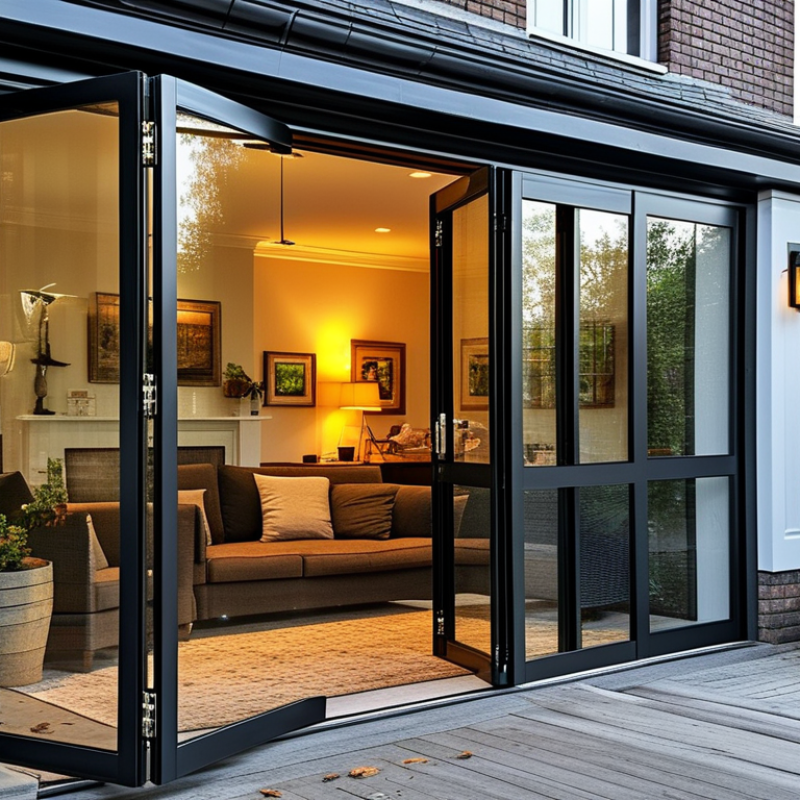
| 5 | Bi-Fold or Folding Patio Door | Two or more hinged panels connected in a concertina arrangement | Panels fold and stack to one or both sides of the opening | Often about 80%–95% of the overall frame width | Excellent; the opening can be adjusted panel by panel | Low to moderate; stacked panels need space at the jamb or inside/outside the opening | Good when a low threshold and appropriately sized panels are used | Moderate to high; numerous panel joints and seals require careful design | Gardens, dining areas, extensions and wide openings intended to open almost fully | Provides one of the widest unobstructed openings and offers flexible partial ventilation | More hardware and seals to maintain; folded panels can project into the opening area |
| 6 | French Hinged Patio Door | Two side-hinged leaves meeting at the center, sometimes with a fixed side panel | Both leaves swing inward or outward from vertical hinges | Typically about 75%–90% of the frame width when both leaves are open | Excellent; either leaf can be opened independently if the hardware allows | Moderate to high; a clear swing arc is required for each leaf | Good with a low threshold, wide leaves and correctly positioned handles | High potential with multi-point locking, thermal breaks and insulated double or triple glazing | Traditional and contemporary homes with sufficient interior or exterior swing space | Wide opening, strong ventilation and a familiar door operation | Needs clear floor space; wind can affect open leaves, and the central meeting point requires good alignment |
| 7 | Single Hinged Patio Door | One operable leaf, often combined with a fixed glazed panel or side screen | One leaf swings on side hinges | Usually about 40%–55% of the overall frame width when installed with a fixed side panel | Good for a single doorway; ventilation is more limited than with paired doors | Moderate; the leaf requires a defined swing arc | Good when the leaf is wide enough and the threshold is low and stable | High potential because the perimeter can be compressed against continuous seals | Small patios, side entrances, utility areas and narrow wall openings | Simple layout, effective weather sealing and straightforward access control | Smaller opening width; furniture and walkways must remain clear of the swing path |
| 8 | Pivot Patio Door | One large, often oversized door leaf with concealed or floor-and-head pivot hardware | The leaf rotates around a vertical pivot point positioned near the edge or farther into the panel | Commonly about 40%–70% of the overall frame width, depending on leaf size and pivot position | Good; the opening angle can be controlled, but the leaf position affects airflow | High; the rotating leaf needs clearance on both sides of its pivot path | Variable; oversized leaves and thresholds may make access more demanding | Moderate to high, depending on the pivot system, seals and leaf construction | Architectural entrances, large feature openings and visually striking contemporary designs | Distinctive appearance, can accommodate wide or tall leaves and creates a strong design statement | Requires careful structural planning; hardware and seals can be more specialized than standard hinged systems |
| 9 | Pocket Sliding Patio Door | One or more sliding panels disappear into a concealed wall pocket when open | Panels slide horizontally into a prepared cavity within the wall construction | Potentially about 80%–100% of the finished opening, depending on the number of pockets | Excellent; the opening can be almost completely unobstructed | Very low in the room, but wall space is needed for the pocket cassette | Good with a flush threshold and reliable, low-force hardware | Moderate to high; the pocket must be detailed carefully to protect insulation, drainage and seals | Minimalist interiors, new-build extensions and spaces requiring a fully clear opening | Nearly disappears when open and preserves a clean, uninterrupted transition between spaces | More difficult to retrofit; repairs may require access to the pocket, and wall detailing is critical |
| 10 | Corner or Meet-in-the-Middle Sliding Door | Two sliding door runs meet at a corner or converge at the center of a wide elevation | Panels slide along separate tracks, often opening toward a corner or away from a central meeting point | Often about 70%–95% of the combined opening width, depending on the corner and track design | Excellent; two directions of opening can create strong cross-ventilation | Very low inside, although the exterior stacking zones must be planned | Good when tracks are level, thresholds are low and panel operation is balanced | Moderate to high; corner junctions and meeting rails require careful weather and air-seal detailing | Corner glazing, panoramic rooms, contemporary extensions and open-plan living areas | Maximizes views, daylight and the sense of connection with an outdoor area | Complex structural and drainage requirements; corner details can be more vulnerable to installation errors |