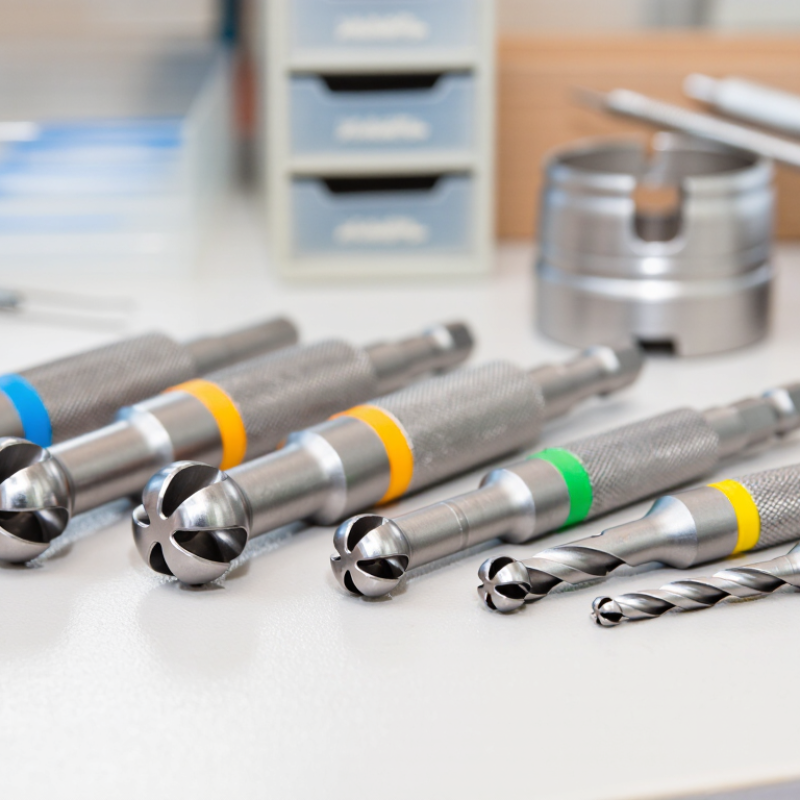
| Primary Function | Dental implant screwdrivers are used to engage, place, tighten, or remove implant components and prosthetic screws. | Production requires accurate driver geometry, controlled concentricity, and secure engagement with the corresponding screw interface. | Confirm the intended clinical application, compatible connection geometry, and whether the tool is intended for manual or torque-controlled use. |
| Common Driver Interfaces | Hexagonal, star-shaped, square, and other proprietary or system-specific interfaces are used in implant dentistry. | Each interface requires dedicated tooling, dimensional inspection, and compatibility control; visually similar profiles may not be interchangeable. | Request engineering drawings, interface tolerances, sample-fit records, and compatibility statements for the target implant system. |
| Typical Materials | Corrosion-resistant stainless steels are widely used for reusable dental instruments; titanium and engineering polymers may be used for selected components. | Material selection affects hardness, wear resistance, corrosion performance, sterilization durability, and magnetic behavior. | Check the material grade, heat-treatment records where applicable, corrosion testing, and material certificates. |
| Manufacturing Processes | Common processes include CNC turning, milling, grinding, broaching, polishing, passivation, laser marking, cleaning, and final inspection. | Small driver tips and internal profiles often require precision machining and dedicated gauges to maintain repeatability. | Evaluate process flow charts, in-process inspection plans, gauge calibration, surface-finish controls, and traceability procedures. |
| Torque Compatibility | The required torque depends on the implant connection, screw design, clinical protocol, and manufacturer’s instructions; there is no universal torque value. | The driver must withstand the specified torque without tip deformation, slippage, or permanent damage. | Ask for maximum recommended torque, torsional-strength test methods, cycle testing, and instructions for use. |
| Dimensional Control | Critical dimensions include tip profile, shaft diameter, working length, overall length, shank geometry, and retention features. | Tight control of the working end helps reduce screw damage, stripping, wobble, and incomplete engagement. | Review inspection reports using calibrated optical comparators, coordinate measuring equipment, gauges, or equivalent methods. |
| Surface Treatment | Polishing, passivation, electropolishing, and selected coatings may be used to improve cleanability, corrosion resistance, or identification. | Surface condition influences particle retention, cleaning effectiveness, corrosion behavior, and patient-contact safety. | Request surface-finish specifications, treatment parameters, corrosion-test results, and evidence that coatings do not interfere with fit. |
| Sterilization Compatibility | Reusable metal instruments are commonly designed for cleaning and steam sterilization when validated according to the applicable instructions. | Repeated exposure to heat, moisture, chemicals, and mechanical cleaning can affect finish, markings, and dimensional stability. | Verify validated reprocessing instructions, maximum reuse guidance, cleaning limitations, and packaging requirements. |
| Quality Management | Medical-device production is commonly managed through documented quality systems, including design control, purchasing control, process validation, and corrective action procedures. | A controlled quality system supports consistent dimensions, batch traceability, complaint handling, and change management. | Confirm current certification to ISO 13485 or an equivalent applicable quality-management requirement and verify certificate scope. |
| Regulatory Documentation | Documentation may include technical drawings, risk analysis, material declarations, test reports, labeling, instructions for use, and batch records. | Complete documentation helps support registration, import review, clinical use, and post-market traceability. | Check whether documents are product-specific, current, signed or controlled, and consistent with the supplied product configuration. |
| China Manufacturing Landscape | The sector includes precision-machining workshops, dedicated dental-instrument factories, medical-device contract manufacturers, and integrated suppliers offering assembly and packaging. | Manufacturing advantages commonly include flexible customization, short tooling cycles, CNC capacity, and scalable production for standard or private-label configurations. | Assess legal manufacturing status, facility capabilities, quality-system scope, production capacity, inspection resources, and supplier-change controls rather than relying only on catalog claims. |