| Dimensional movement | Representative matched-humidity comparison: approximately 0.30% panel movement in the cross-grain direction. | Approximately 0.50% movement in the same comparison condition. | Equivalent to a calculated reduction of approximately 40% in movement: (0.50 − 0.30) ÷ 0.50. |
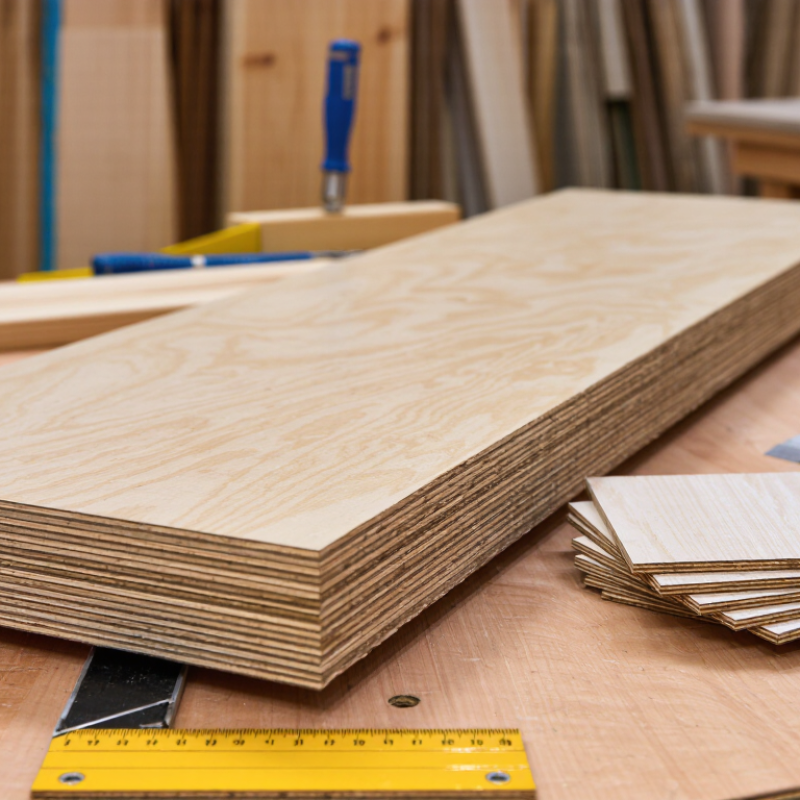
| Veneer structure | Thin wood veneers are bonded with adjacent layers oriented at approximately 90° to one another. | Fibers generally run predominantly in one direction across the board. | Cross-lamination balances lengthwise and crosswise movement and helps reduce cupping, twisting, and warping. |
| 24-hour thickness swelling | Common interior plywood constructions: approximately 4–12%, depending on wood species, adhesive system, density, and edge exposure. | Solid wood does not use the same thickness-swelling test; moisture primarily causes movement across the grain. | More predictable panel thickness for cabinet sides, shelving, drawer components, and furniture carcasses. |
| Moisture-related movement | Lower across-panel movement than solid wood because alternating veneer directions restrain one another. | Cross-grain movement can be several times greater than lengthwise movement. | Helps maintain door gaps, drawer alignment, and flush-fitting joints when indoor humidity changes. |
| Surface quality | Selected face veneers can provide a smooth, uniform surface suitable for clear finishing, staining, painting, or laminating. | Surface appearance depends strongly on species, board quality, grain pattern, and defect filling. | Reduces preparation work and provides a consistent appearance for visible furniture panels. |
| Screw and fastener performance | Multiple bonded veneer layers provide holding material through the panel thickness; pilot holes are still recommended near edges. | Fastener holding is strong along the grain but can be less predictable near end grain or split-prone areas. | Supports reliable assembly of cabinets, shelving, tables, and joinery components. |
| Thickness options | Common nominal thicknesses include 6, 9, 12, 15, 18, and 25 mm. | Thicknesses are normally selected from solid boards or laminated blanks and may require additional machining. | Offers practical sizing for structural panels, drawer boxes, doors, backs, and carcasses. |
| Weight consistency | Typical panel density commonly falls within approximately 450–700 kg/m³, depending on species and construction. | Density varies widely by wood species and moisture content. | Makes material planning, cutting, transportation, and hardware selection more predictable. |
| Best-use environments | Well suited to controlled interior environments; moisture-resistant or exterior-rated panels are required for damp or exposed applications. | Requires careful sealing, acclimatization, and allowance for seasonal movement. | Provides stable performance for interior furniture when the correct adhesive and surface finish are specified. |